ECCV 2026

Test-Time Registers as Global Priors for Tokenized Image Generation

Cheng-Yao Hong1* Yifan Wang1* Yuewei Lin2 Chenyu You1

1 Stony Brook University

2 Brookhaven National Laboratory

* Equal contribution

News

  • RegToken was accepted at ECCV 2026.
  • The paper is available on arXiv.

Overview

Turning register structure into a compact global prior

Vision transformers can develop attention sinks: a small set of tokens repeatedly receives attention and accumulates unusually large activations. In vision models, these outliers are associated with registers and carry smooth, scene-level information that is distinct from both [CLS] readouts and local patch summaries.

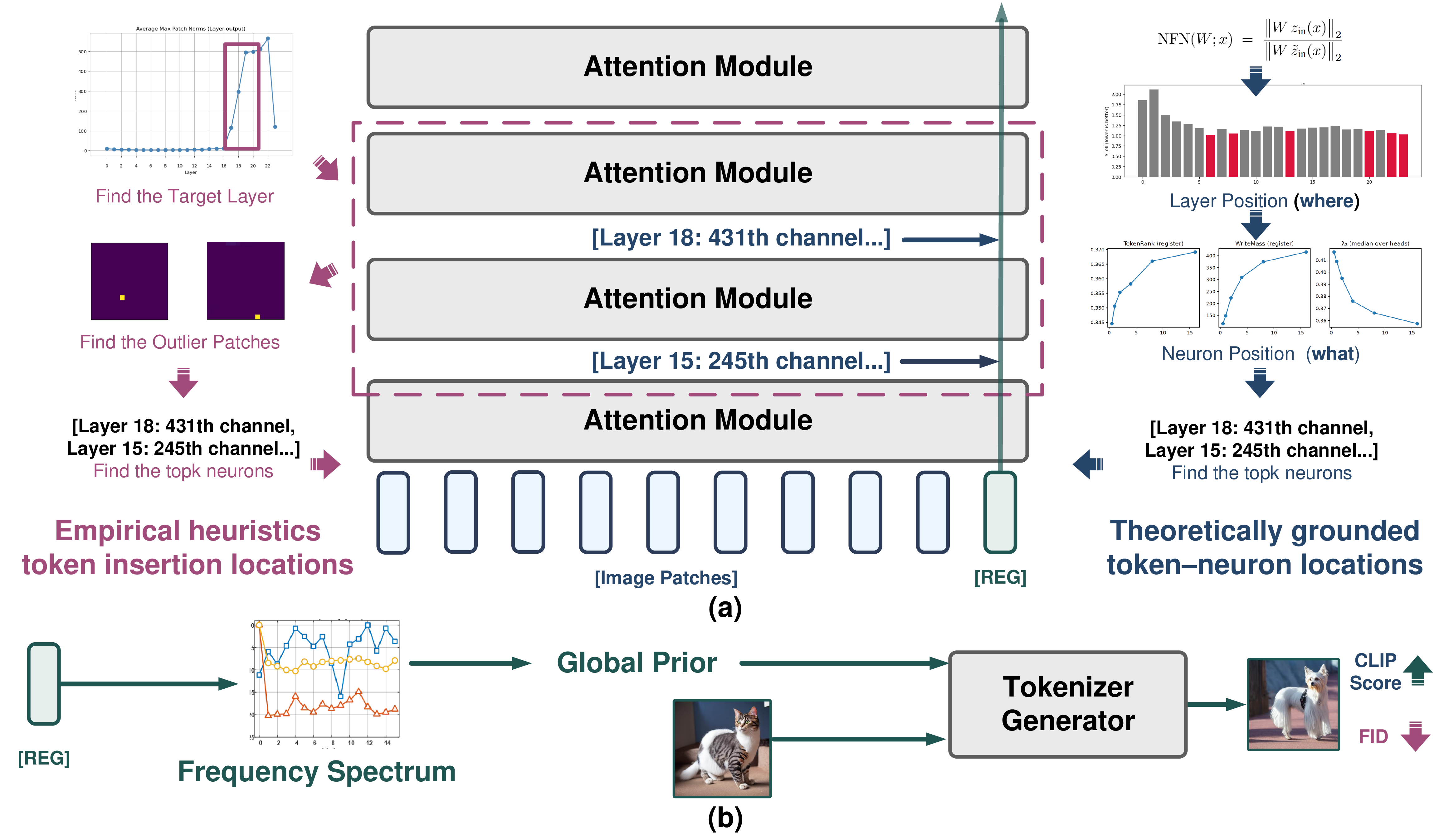
RegToken is a training-free procedure that converts this frozen register structure into a small set of global prior tokens. The priors are inserted into a compact 1D token generation pipeline to supply global context, without modifying pretrained backbone or decoder weights.

Method

A four-stage, frozen-model procedure

  1. 01

    NFN-based localization

    Normalized Feature Norms identify the layers and modules where register-related amplification is most prominent.

  2. 02

    TokenRank-guided extraction

    TokenRank-guided importance identifies register neurons and the corresponding register subspace.

  3. 03

    Projection and conservation

    A projection-and-conservation update constructs RegToken from the register subspace while approximately preserving its global statistics.

  4. 04

    Frozen-token insertion

    The resulting global prior tokens are inserted into a frozen compact 1D token generation pipeline.

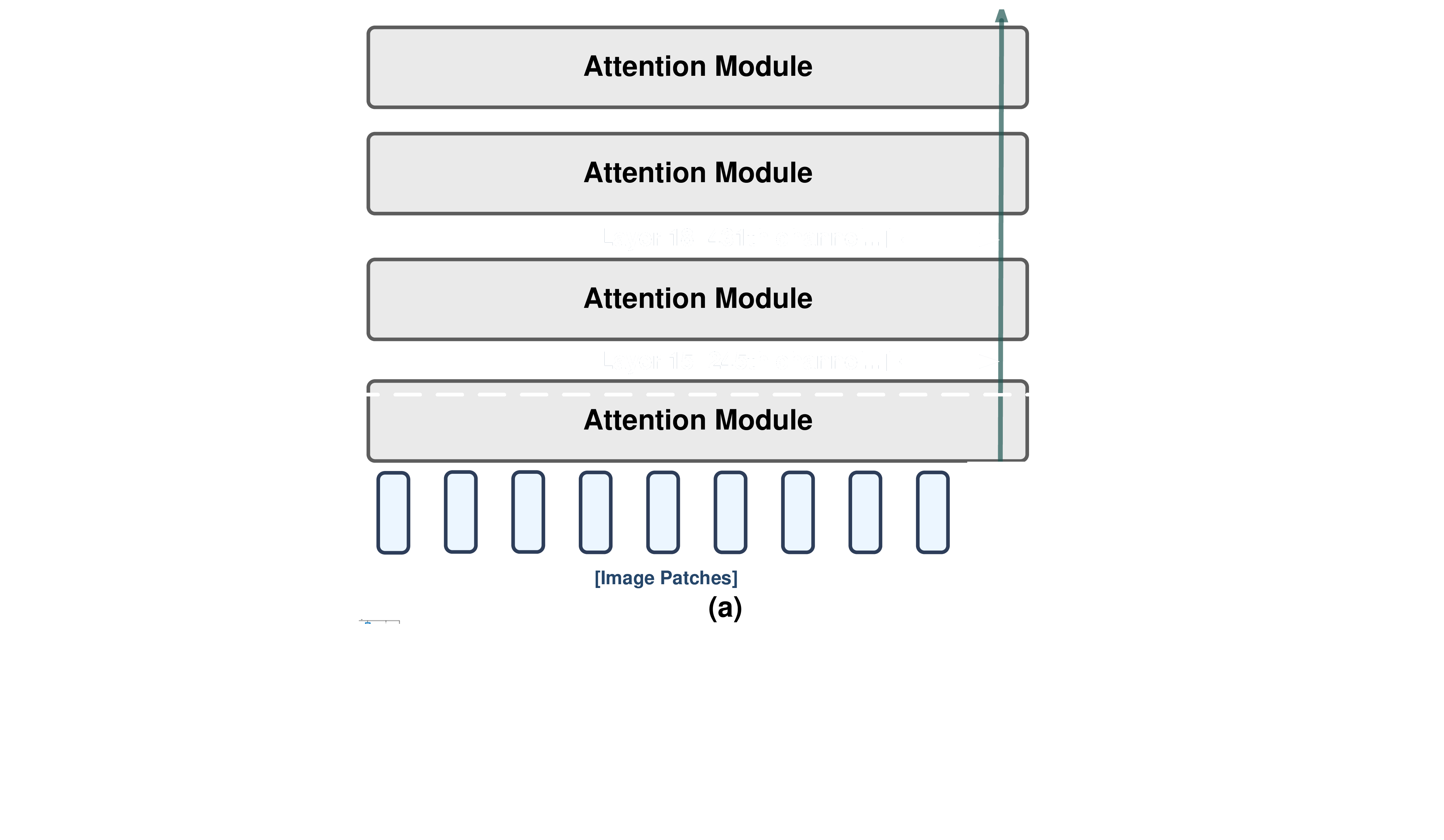
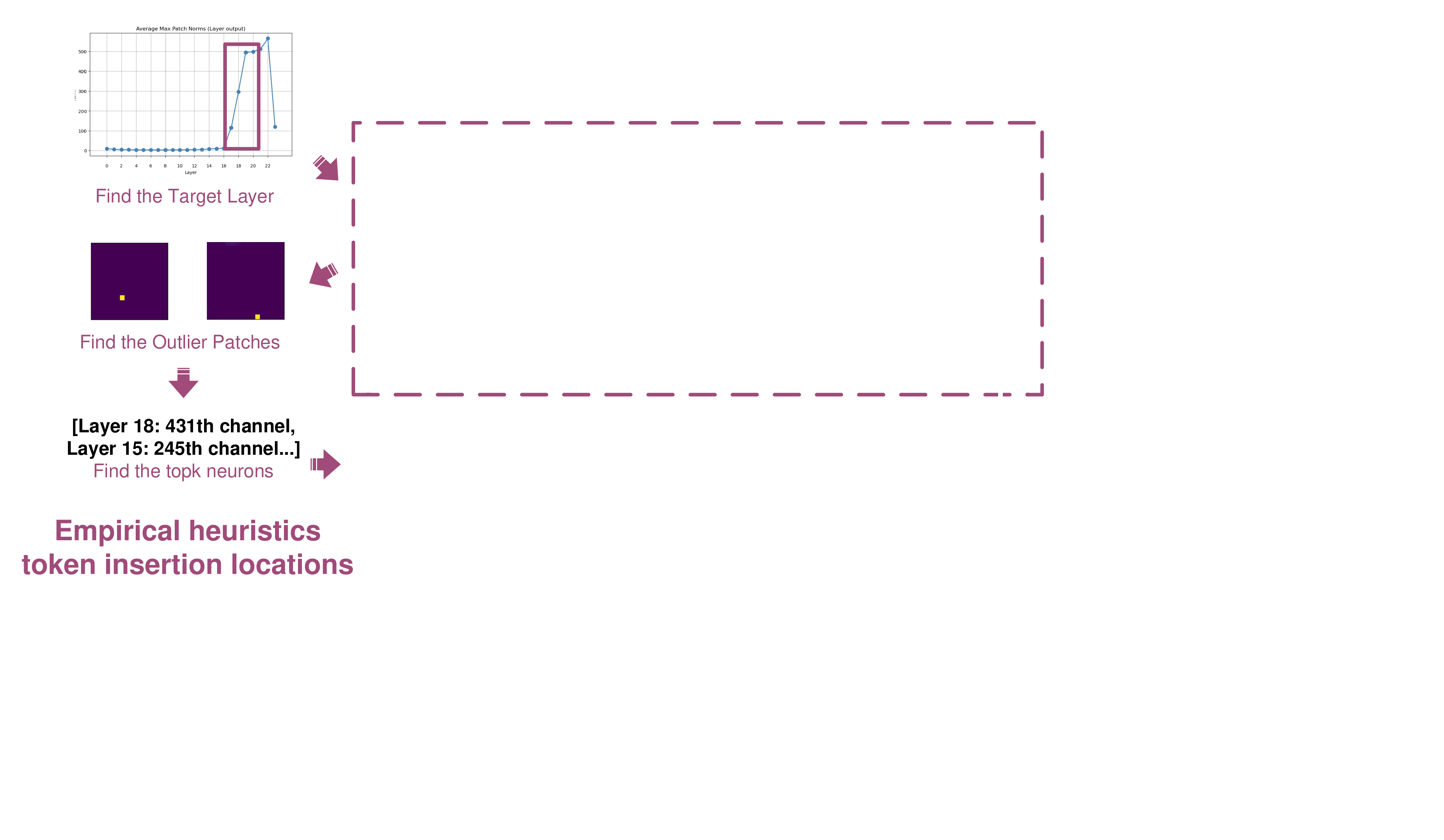
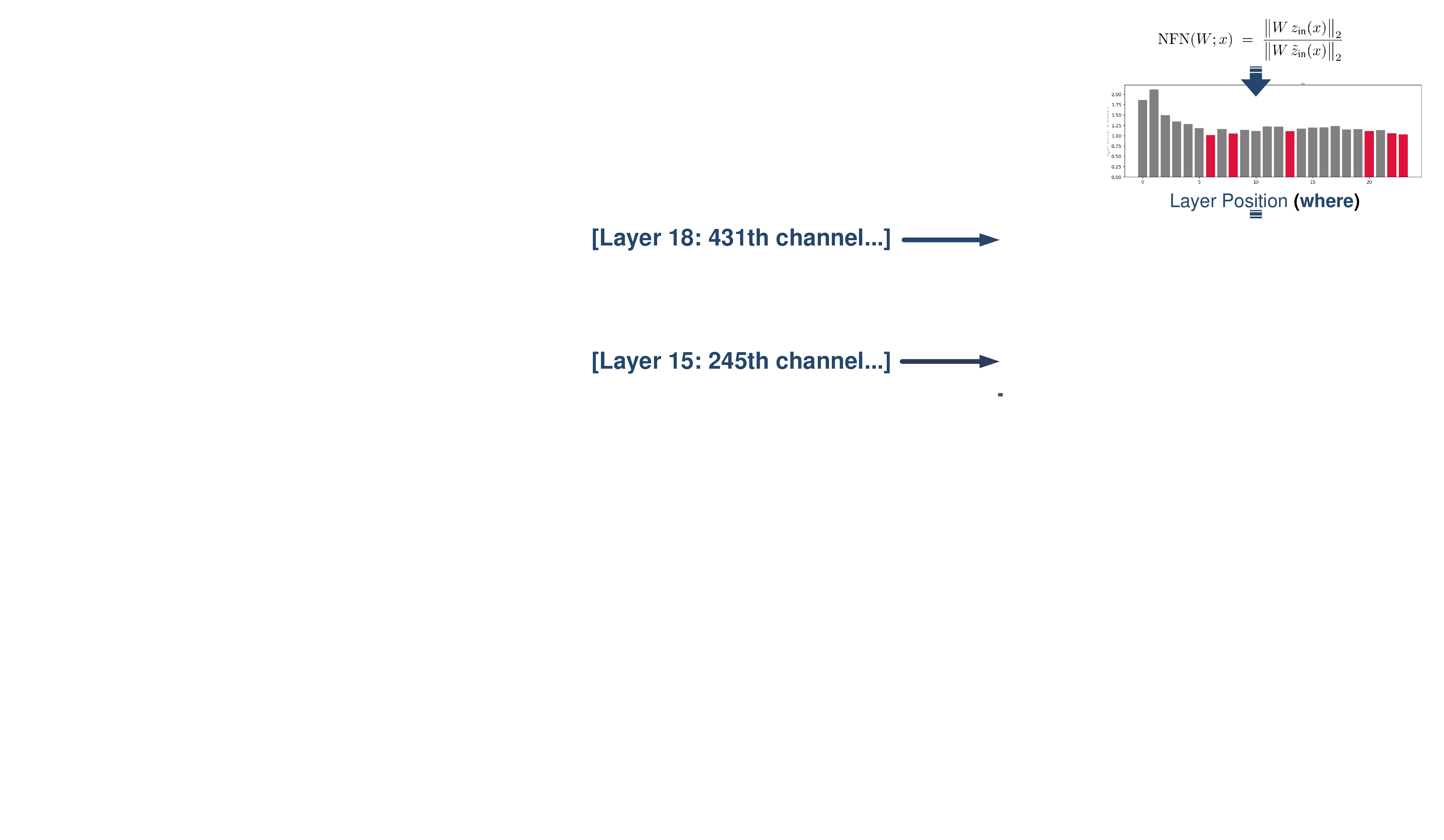
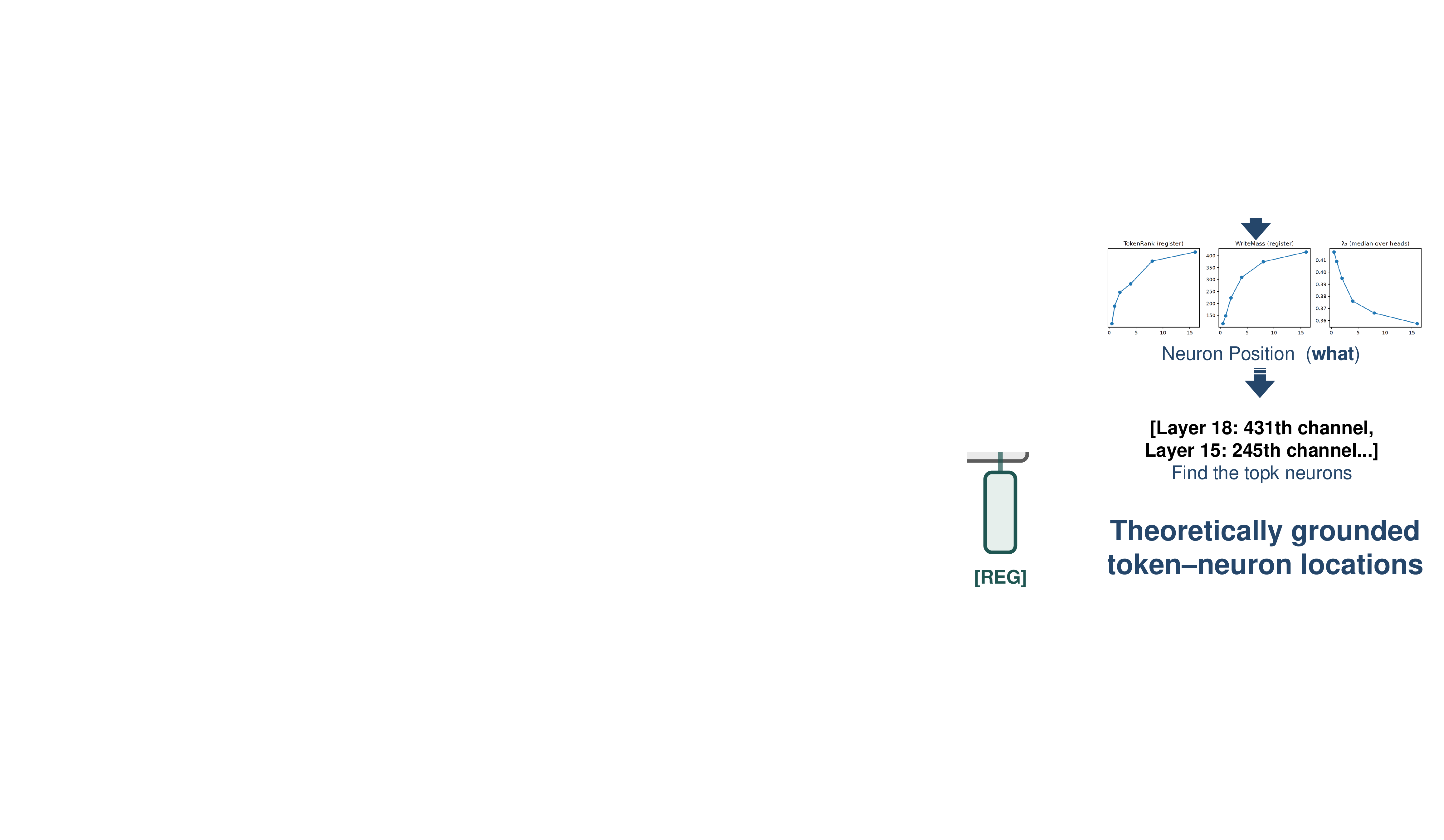
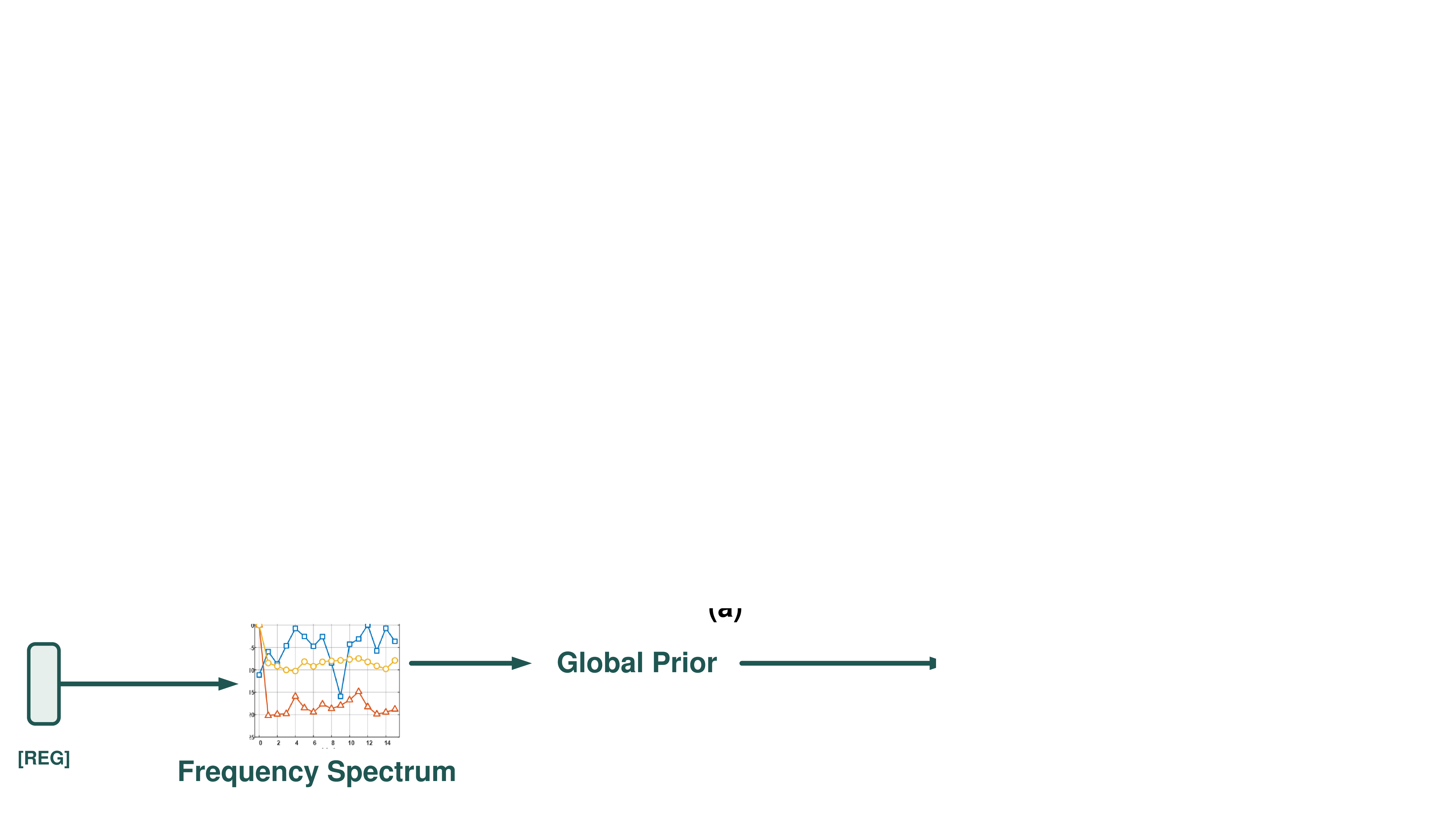
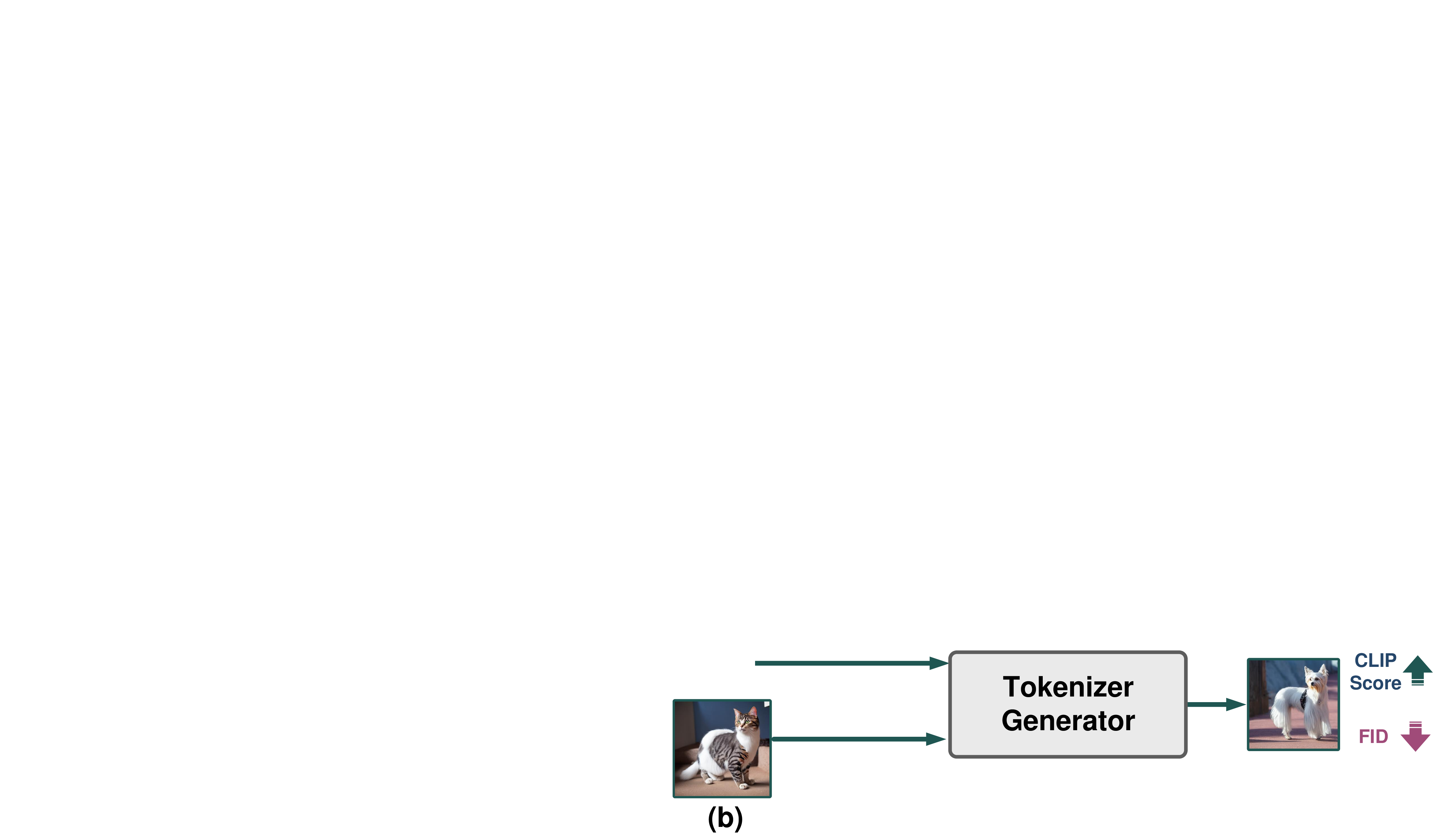
RegToken overview: NFN and TokenRank identify register-related layers and neurons, then a register-derived global prior is passed to a tokenizer generator.
Method overview. RegToken localizes register structure in a frozen vision transformer, constructs a global prior, and inserts it into tokenized generation.

Feature-spectrum analysis

Register features emphasize low-frequency structure

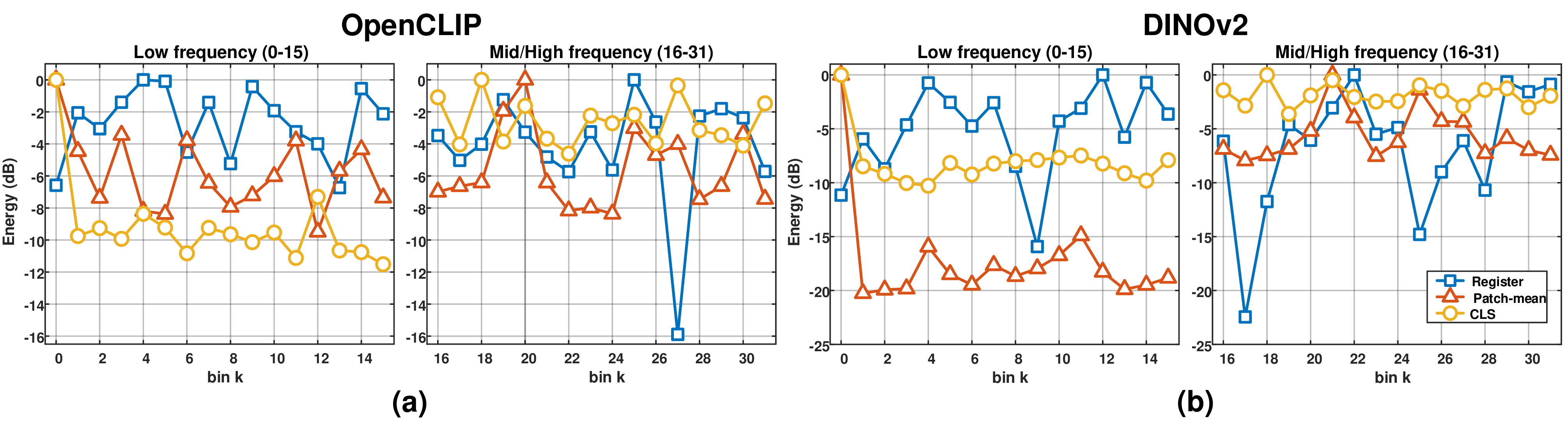
Across DINOv2 and OpenCLIP, register-associated features show stronger low-frequency concentration than both [CLS] and patch-mean features. The analysis compares feature spectra, rather than treating these signals as direct pixel measurements.

The relationship to pixel-space DCT low-frequency energy is consistent but moderate, supporting an association with global image structure without claiming a perfect correspondence.

Feature spectra for register, patch-mean, and CLS features in OpenCLIP and DINOv2, separated into low and mid/high frequency bins.
Frequency analysis. Register-associated embeddings show stronger low-frequency concentration than the compared token summaries.

Analysis

Register dynamics

What happens after register insertion?

With a single register token inserted at NFN-selected layers using the top-50 register neurons, the register accumulates large norm and CLS-to-register attention mass. The norm and attention statistics of image tokens remain largely unchanged.
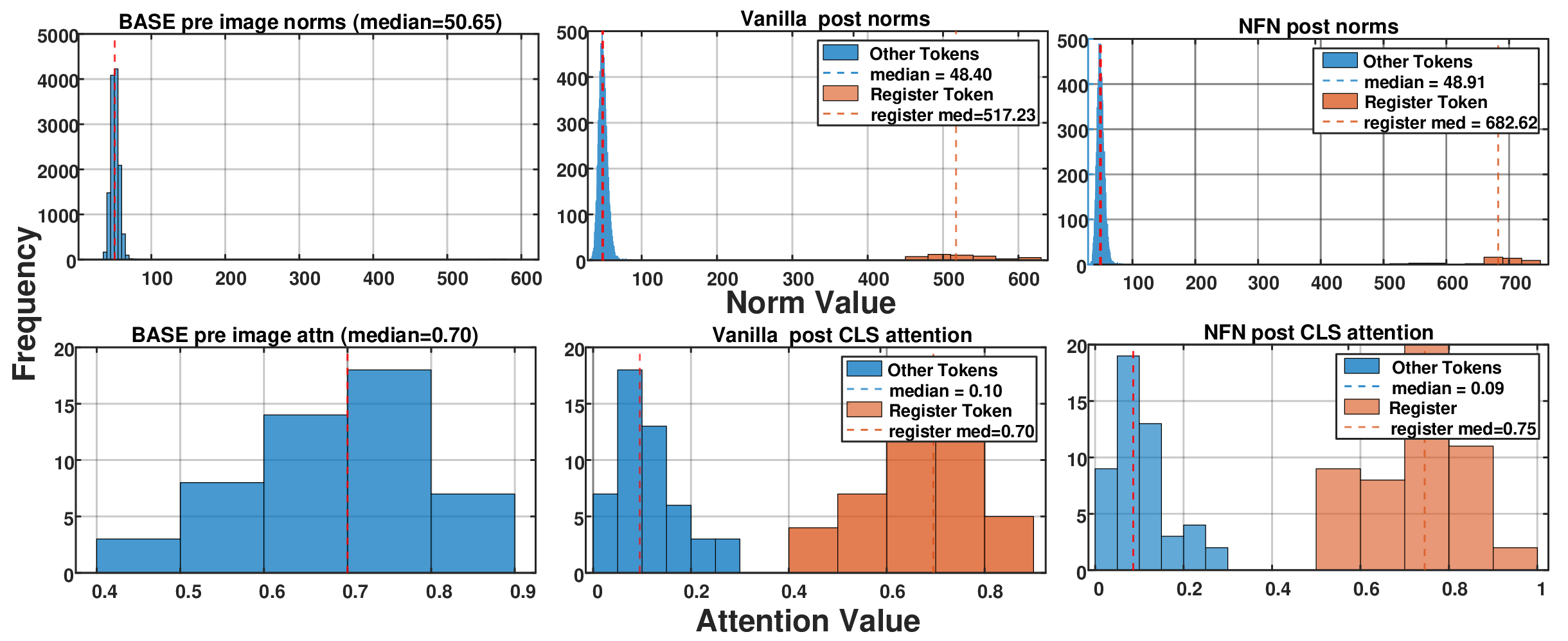
Six DINOv2 histograms comparing image-token and inserted-register norm values and CLS attention before insertion, after vanilla insertion, and after NFN-guided insertion.
Effect of register insertion on DINOv2 features. The inserted register concentrates the reported norm and attention mass while image-token statistics remain comparatively stable.

Outlier suppression and attention mixing

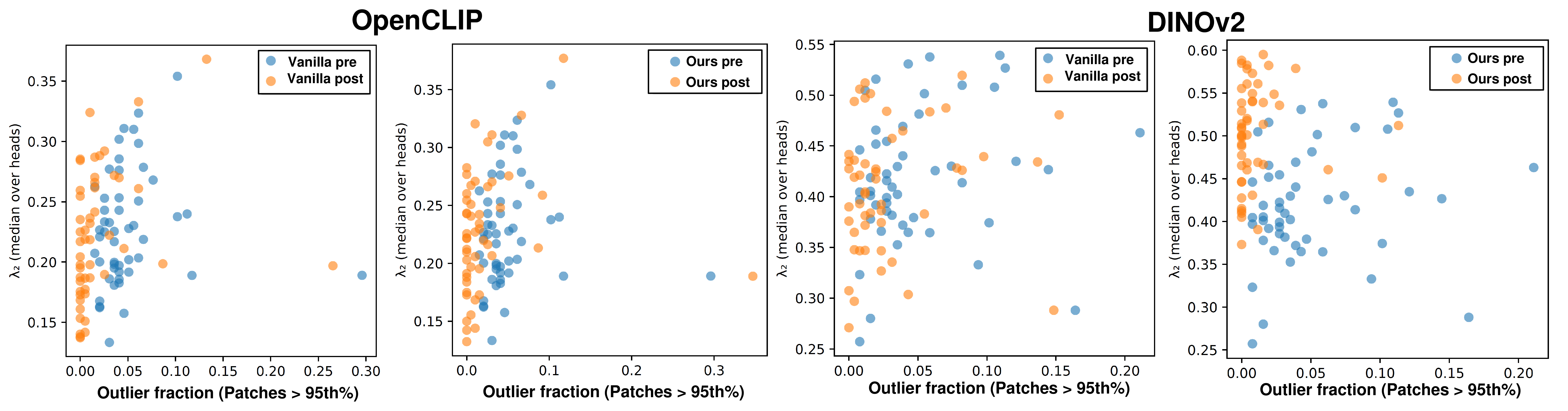
Each point pairs the fraction of patch tokens above the pre-95th norm threshold with λ₂, the second eigenvalue of the attention Markov chain (median over heads). Vanilla test-time registers show a modest shift toward fewer outliers and lower λ₂; the NFN-guided, head-gated variant shows a larger reduction in outliers and a clearer drop in λ₂, which the paper associates with stronger mixing.

Four OpenCLIP and DINOv2 scatter plots of lambda two, median over heads, against the fraction of patch tokens above the pre-95th norm threshold, comparing pre and post results for vanilla and NFN-guided methods.
Correlation between λ₂ and outlier tokens. The NFN-guided, head-gated variant shows the clearer reported shift in both quantities.

ImageNet results

Global priors improve quality, alignment, and efficiency

FID-5k

20.520.1

Lower is better

SigLIP

3.63.9

Higher is better

Steps@τ

7452

Lower is better

Qualitative results

Diverse decoding examples

Citation

Provisional citation

@inproceedings{hong2026regtoken,
  title={Test-Time Registers as Global Priors for Tokenized Image Generation},
  author={Hong, Cheng-Yao and Wang, Yifan and Lin, Yuewei and You, Chenyu},
  booktitle={European Conference on Computer Vision},
  year={2026}
}